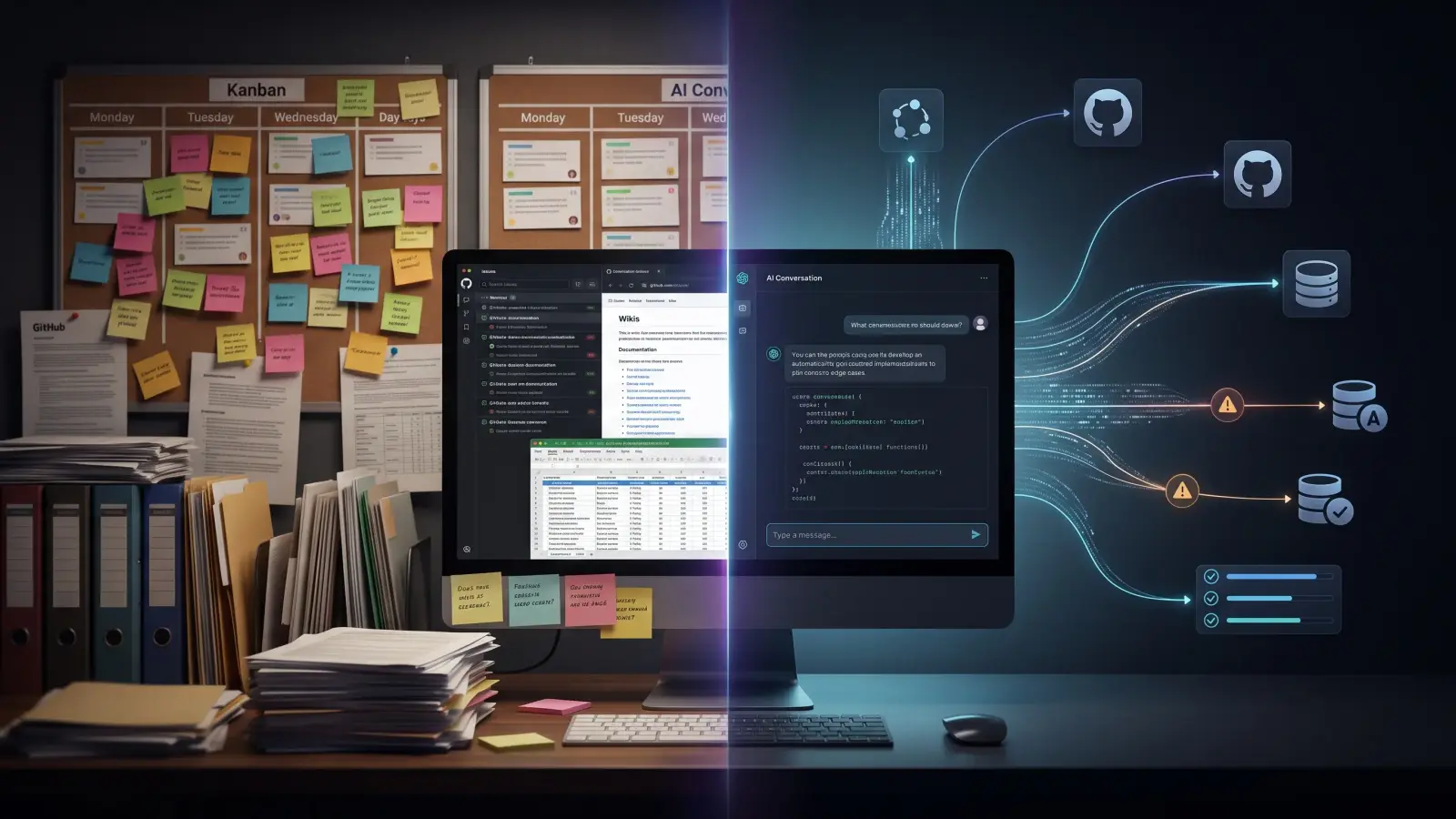
We are in a stage of AI development where everything we need to do has to be rethought: how we arrange our thoughts, how we build software, and how we deploy software. It’s a time where we need to take a sledgehammer, bring it all down, and make sure that everything is new and exciting in a way.
The same goes for my thought process and my planning phase as well.
TL;DR
Artificial intelligence is forcing us to rethink more than just how we write code. It’s changing how we organize our thoughts, plan features, manage software projects, and collaborate with our tools.
After years of using GitHub Issues, Linear, Jira, Notion, and countless productivity systems, I’ve realized they all suffer from the same problem: friction.
Instead of managing tickets, I want to describe what I want to build in plain English and let AI understand the project, generate implementation plans, identify edge cases, and even hand the work directly to coding agents like Claude Code or Codex.
This isn’t a finished product—it’s an idea. But I think this is where software development is heading.
Context
So, a little bit of context here. I have a lot of open-source projects that I love to work on. I have Virtual, Crisp, Portal, Quinn, envpilot.dev, Lumo, and a bunch of other applications and projects that I really love. But managing all of them—managing all the bugs, issues, and new features—is a pain. It’s not good.
It’s a pain in the ass to deal with. I have tried multiple planning and project management tools. Either they are way too complex, or they require too much setup, and you get trapped in an infinite loop where you keep iterating and reiterating. Then, when it’s finally time to use them, you never do.
The Productivity & Notion Trap
I saw a video online from a YouTuber, I think they’re called Efficient App (Alex & Andra), and they pointed out the trap of Notion and other similar tools. That’s exactly where I see myself. I set up Notion with boards and dashboards everywhere, and what happens at the end of the day is that, after everything is set up, I don’t use it that much.
In that video, they explained how Notion uses its online presence to create this urgency that it is the one platform and tool for everybody. That can be true for some purposes, but not for others. They went deep into how things are set up and where things are going, but the main point for me was that I completely agreed with their viewpoint. It was a solid eye-opener.
And this is not the only video out there. Even Linear, which has been one of the ultimate issue-tracking tools alongside Jira that I’ve used in the industry for many years now, is coming out with its own blog post saying that issue tracking is kind of dead.
Here is the official blog post from Linear.
And as you can see, things are really changing. But how we’re going to interact with these tools is still a big problem. We understand that there has to be some kind of tracking. There has to be some kind of backlog. There have to be new features, and there have to be bugs that need to be tracked as well. But with the rise of AI, Codex, Claude Code, and these new Chinese models, we can do a lot more in a much more fun and creative way to figure out which things are going in the right direction.
The old method of project management is completely broken.
Here’s the thing. A normal project manager goes to the client and figures out what’s missing. They work with a business analyst, a business manager, or a strategy team. Then they go to the business and start identifying how things are going to work, what the current flow is, what needs to be solved, and how the process should work.
They define the processes, decide what features need to exist, and once they have everything they need, they create documents like system diagrams, SSDs, system design documents, or follow Agile methodologies. Then they go into an issue-tracking tool like Linear, Jira, GitHub Issues, or GitHub Projects. They set everything up, create the sprints, assign a bunch of tickets to developers, and the team starts building the project. Once features reach a certain stage, they move to QA to make sure everything works from development to staging to production.
This has been the monolithic structure for years, even before the age of AI.
Now things are in a place where I can clearly see that issue tracking is fundamentally broken.
There is no way on earth that we’re at a stage where this is still the best way to do things. Linear even said that issue tracking is dead, as you can see in their blog post. Jira hasn’t come out with any kind of statement yet, but this is definitely something we should be thinking about.
And I realized that I spend one or two months setting up a tool, then I use it occasionally, but there is always one little friction point that matters a lot. After that, all the other work really doesn’t matter anymore, and I stop using the tool altogether.
That was their point of view, and I kind of see it not just with Notion but with every little problem that I try to solve. Every piece of software I try has that one little friction point when trying to build a second brain—a place to dump thoughts in a way that they can be organized, searched, and easily manifested.
And I’m at a point where I do not want to build another tool, but maybe I’ll find another tool that fits my requirements. Or maybe I should see this as an opportunity to make something happen.
Another aspect that matters to me a lot.
The big idea
So let’s talk about the idea.
How do we solve this problem?
Because we have identified the cost. We build or set up certain tools, we use them for a while, but then that little friction point appears, and we abandon them.
For example, this platform I’m writing this blog post on, wryte.xyz. I use it on a daily basis. It’s a tool that I thought I might use once or twice, but now I’m using it almost every day for writing all of my content, all of my blog posts, and all of my ideas. I love it because there isn’t a friction point for me. It’s a wholesome experience.
I removed a lot of manual work from my life by writing blog posts on one consolidated website where I can just hook everything up and make things happen. It’s still not polished enough. There are still little things that need to be improved, but they are side issues and not a big deal for me. Ninety percent of my work for writing content can be done there.
But for managing all of my projects, it’s not the same thing.
I have tried GitHub Issues, backlog.md, Linear, and even Notion, but none of them fit into the category that I’m looking for.
The Solution
So what’s the solution?
Here’s what I’m thinking.
It’s going to be a simple text box where I’ll sign in with my GitHub account and get access to all of my GitHub projects. I’ll select certain projects, or maybe all of them, and there will be a small local LLM that gets context from each repository—for example, by reading the README or something similar. Maybe it gets the project names and stores them permanently in its memory.
Then I just open the web app or desktop application—I don’t know which platform I’m going to go with right now—and I’ll say:
“EnvPilot, I need to add a new feature. I need to add a GitHub Action for this project.”
For example, if anybody wants to fetch their environment variables for builds, production, or anything else, they can do that.
Then the AI model, or the local AI model, understands that I’m talking about this specific project. It already knows the project, understands the feature I want to build, identifies multiple edge cases, creates a rough plan, maybe a rough schema diagram, and generates the to-do list, scheduling, and estimated time required.
Then there will be a small Kanban board with four or five stages: To Do, Started, Review, Merged, and Completed.
There will also be a button. If I click that button, since it’s already linked to my GitHub account, it can create a bunch of GitHub Issues or future plans automatically. Although I’ve come to realize that GitHub Issues are fundamentally broken, and I don’t really want to deal with them. So that’s one possible direction.
Maybe it could be a desktop application built with Electron. I could use Convex, TypeScript, Effect, and tRPC to make sure every single piece is working properly.
There could also be a button that says “Implement this feature in Claude Code.” When I click it, it would trigger my terminal, open Claude Code, and inject the basic description automatically.
Something like:
“This project is in my metadata. Here is the feature that I want to implement. Go do your research and implement it.”
That way we can also use the LLM to detect defects, identify edge cases, and maybe have a notes and description section where I can edit things manually if I want. Or I could have a full recall system powered by an LLM where I can simply ask:
“What’s my to-do list for this project?”
And it gives me a dead-simple answer. Keep it vibey. That’s the kind of vibe and experience that I’m looking for.
I don’t know if this is a perfect solution or not. I don’t know whether it’s going to work.
I also don’t know how I’m going to monetize this app because I really don’t want to integrate Claude SDKs or OpenAI SDKs and then charge for API keys. That’s an expensive bill that might come my way, and I don’t want to deal with that.
I would really prefer a desktop application. Maybe Electron, or maybe Deno. I heard Deno is a really good framework for this. If I go with Electron, I can support both macOS and Windows. I don’t want to go with SwiftUI anymore. I’ve already been there, and maintaining one application after another is kind of a nightmare.
I could charge a one-time lifetime fee that includes updates, open-source it as well, and use local LLM models so everything runs really fast.
If a system isn’t capable of running a local LLM, then we can switch to an API provider. Having a Bring Your Own API Key section would be a much better approach.
So that is my entire plan, thought process, and brain rot that has been happening over the last couple of days. I’ve been thinking a lot about how we can manage projects better and where things are going.
But let’s see.
Until then, see you next time, nerds.
Discussion
Share your thoughts and engage with the community