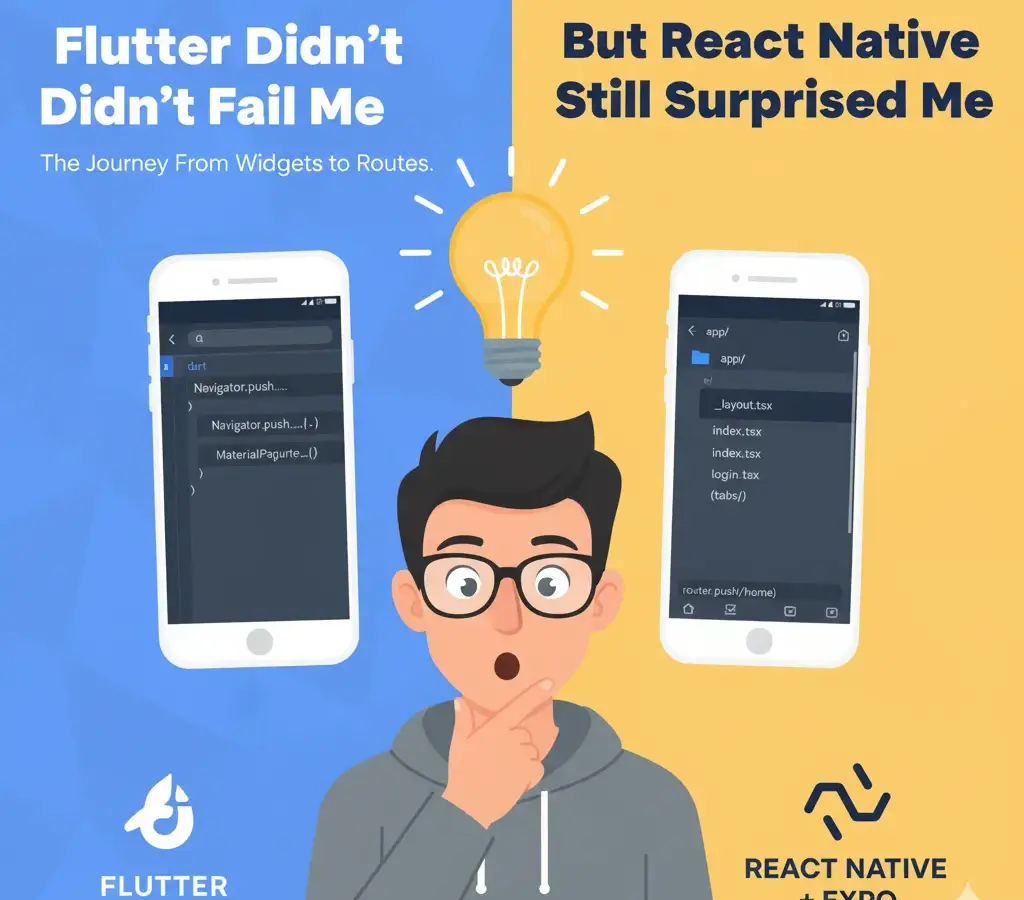

If you’ve been shipping mobile apps for more than five minutes, you know the feeling.
Your tech stack works. Your apps ship. Nothing is arguably broken… yet something keeps tapping you on the shoulder.
Flutter was that safe house for me. For years, it was my default answer for Android and iOS. It was fast, strongly typed, and honestly hard to argue against. I shipped apps, billed clients, and never felt like Flutter was the bottleneck. So when the Twitter (X) tech influencers kept shouting “You have to try React Native now, it’s different!”, my reaction was a standard developer eye-roll.
Why?
Rebuilding an app in a new framework just to “see the vibes” is a terrible way to burn a weekend. Refactoring for curiosity doesn’t pay the bills. And React Native? It always felt like that chaotic JavaScript thing I’d get to eventually.
Until one Tuesday evening, bored and over-caffeinated, I finally bit the bullet.
What started as a “quick experiment” with Expo turned into a complete existential crisis regarding how I handle navigation, styling, and my mental model of mobile development. No hype. No “Flutter is dead” clickbait. Just a genuine “Oh… I’ve been making this harder than it needs to be” moment.
In this post, we’re cutting through the fanboy noise to look at:
- The “Context Hell” taking a vacation: How Expo Router fixed my brain.
- The Styling Shock: Why CSS-ish styling felt oddly refreshing after years of Widget trees.
- The Verdict: What Flutter devs can steal from React Native without actually switching.
This isn’t a breakup letter to Flutter. It’s more like admitting I cheated on my main stack and learned some new tricks.
Flutter Was My “Comfort Hoodie”
Flutter didn’t just work—it fit.
One codebase. Google-backed stability. Strong opinions baked into the framework. Once you swallow the pill of “Everything is a Widget,” life is predictable.
Navigation? Sure, it’s verbose, but it’s explicit. You know the drill:
Navigator.push(
  context,
  MaterialPageRoute(
    builder: (context) => const SecondPage(
      message: 'Please don\\'t lose context',
    ),
  ),
);
There’s no mystery here. You are grabbing the context by the throat, building a route, and shoving it onto the stack. It’s disciplined. It’s safe.
And styling? You don’t “style” a button; you construct it. Padding inside a Container inside a Row inside a Column. It’s a deep tree, but at least you know exactly where the padding is coming from (spoiler: it’s always the parent widget you forgot about).
So when people talk about Flutter “falling behind,” I laugh. Flutter is fine. It’s great, actually.
Which is exactly why React Native never felt urgent. I didn’t need “faster hot reload” (Flutter’s is fine). I didn’t need JavaScript (I actually like types, thanks).
From the outside, React Native looked like the Wild West. npm install roulette? dealing with Bridge issues? No thanks. I stayed in my typed, compiled, widget-safe lane.
Until curiosity—and boredom—won.
Why React Native Never Clicked… Until It Did
I’d heard the pitch:
- “Expo makes it easy.”
- “Over-the-air (OTA) updates are a cheat code.”
- “It’s just React.”
Cool. Still didn’t care.
The blocker wasn’t the tech; it was the setup tax. I didn’t want to wrestle with Xcode versions or Gradle daemons just to render “Hello World.”
But then I tried Bun.
If you haven’t used Bun, it’s what Node.js wishes it was. Fast. absurdly fast. I initialized an Expo project using Bun, fully expecting to spend 30 minutes debugging environment variables.
Instead, the app was running on my phone in seconds.
I opened the project file structure and immediately felt that specific developer panic: “Where is the main file?”
There was a tabs folder. A layout.tsx. Files that looked like URL routes. Nothing resembled the main.dart entry point I worshipped. In Flutter, I build the screens, I define the routes, I control the universe. Here, it felt like the file system was controlling me.
So I did the standard procedure:
- Panic.
- Google “Expo Router wtf”.
- Ask ChatGPT to explain it to me like I’m 5.
And then it clicked.
Stop thinking about it as a Mobile App.Start thinking about it as a Website.
The moment I realized Expo’s folder structure is basically the Next.js App Router, the headache vanished. Files aren’t just code; they are URLs. Layouts aren’t wrappers; they are persistent UI shells.
That was the first crack in my Flutter armor.
The Expo Router Epiphany: Files Are The Roadmap
Once I stopped fighting the folder structure, I realized how much boilerplate I had been writing in Flutter.
In an Expo Router project, your file system is your navigation map.
app/
 ├─ _layout.tsx      <-- The Wrapper (think Scaffold)
 ├─ index.tsx        → route: /
 ├─ login.tsx        → route: /login
 └─ (tabs)/
    ├─ _layout.tsx   <-- Tab Bar Logic
    ├─ profile.tsx   → route: /profile
    └─ settings.tsx  → route: /settings
If you’ve touched Next.js, you’re nodding your head. If you’re a Flutter dev, you’re probably squinting. “Where is the Route definition map?”
There isn’t one. You just make a file.
Navigation Without the Ceremony
In Flutter, moving between screens is a grand event. You need the context, you need the class name, you need the params.
In Expo Router, you just… change the URL.
import { router } from "expo-router";

// Look ma, no context!
router.push("/home");
router.replace("/login");
router.back();
No BuildContext. No generic type arguments. No importing the screen widget file.
You aren’t pushing a screen. You are changing location.
This sounds like semantics, but it changes everything. Authentication redirects? Just check the user state and replace the URL to /login. Deep linking? It works out of the box because every screen is already a URL.
In Flutter, Deep Links are a configured nightmare in AndroidManifest.xml and Info.plist. In Expo, they just… work.
Styling: The “Utility First” Shock
Flutter developers take pride in the Widget Tree. We love our Padding(child: Center(child: ...)).
React Native (specifically with NativeWind, which is just Tailwind for mobile) feels like cheating.
Flutter:
Container(
  padding: const EdgeInsets.all(16.0),
  decoration: BoxDecoration(
    color: Colors.blue,
    borderRadius: BorderRadius.circular(8),
  ),
  child: const Text('Click Me'),
)
React Native + NativeWind:
<View className="rounded-lg bg-blue-500 p-4">
  <Text>Click Me</Text>
</View>
Is it “cleaner”? Debatable. The HTML/CSS purists hate it. Is it faster to write? Absolutely.
Separating style from logic (even if it’s just utility classes) felt weirdly liberating. I wasn’t fighting the nesting indentation hell that complex Flutter layouts sometimes turn into.
The Side-by-Side: Logic & State
This is where the “Web DNA” of React Native shines.
In Flutter, state management is a religion. Are you Team Provider? Team Riverpod? Team Bloc? Team “GetX is the devil”?
React Native just uses Hooks.
export default function Counter() {
  // It's just React.
  const [count, setCount] = useState(0);

  return <Button title="Increment" onPress={() => setCount(count + 1)} />;
}
Local state is trivial. Global state? Wrap the root layout in a Context Provider. Async stuff? useEffect (just don’t forget the dependency array, or you’ll infinite loop your API quota).
For backend, I threw in Convex and Firebase.
- Flutter: Requires platform channels, specific packages, and sometimes native configuration.
- React Native: It’s basically just JavaScript. If it works on the web, it probably works here.
What Flutter Devs Can Learn (Without Switching)
Look, I’m not saying “Delete your Flutter repo.” Flutter is still king for performance-heavy, animation-rich, custom UI apps.
But React Native taught me:
- URL-Based Thinking is Superior: Even in Flutter, try to model your navigation state as a “path” rather than a stack of cards. It makes deep linking and web support much less painful later.
- Less Boilerplate is Okay: We sometimes over-engineer Flutter apps with “Clean Architecture” for a simple To-Do list. React Native’s “just write the component” attitude is a good reminder to ship faster.
- The Web ecosystem is massive: React Native lets you piggyback on the entire JavaScript npm ecosystem. Flutter is catching up, but JS libraries are infinite.
Conclusion: Use Whatever Ships the App
Flutter isn’t going anywhere. It’s solid. It’s compiled. It’s Google.
React Native isn’t perfect. node_modules is still the heaviest object in the universe, and sometimes the bridge between JS and Native code acts up.
But Expo has closed the gap.
If you are a Flutter developer, this isn’t a “switch or die” warning. It’s a suggestion to peek over the fence.
Go create a folder. Run npx create-expo-app@latest. Get confused by the folder routing. Scream at a missing dependency.
But then, watch the lightbulb turn on when you realize you just built a cross-platform app with fully working deep links in 20 minutes.
Because at the end of the day, users don’t care about your StatelessWidget or your useEffect. They care about the app on their home screen.
Now, go build something.
Discussion
Share your thoughts and engage with the community